
This article gives couples concrete deep talk questions organized by theme, along with tips for when and how to ask them so the conversation feels natural instead of like an interview.
Published
Deep talk questions for couples are prompts that go past "how was your day" and get into what someone actually fears, wants, or remembers.
Why Do Couples Need Deep Questions At All?
Most couples talk every day and still don't know some of the biggest things about each other. Logistics fill up the space that real conversation used to have — who's picking up dinner, what time the call starts, whether the package arrived. None of that is bad, but it doesn't tell you anything new about the person you're with.
A deep question forces a different kind of answer. It asks for something the other person hasn't said out loud in a while, sometimes ever. That's what makes it worth doing on purpose instead of waiting for it to happen naturally, because for most couples it doesn't happen naturally very often.
What Are Some Deep Talk Questions to Actually Ask?
Pick from these based on the mood of the night. You don't need all of them, and you definitely don't need to ask them back to back like a quiz.
- About love: "When did you know you loved me, and what were we doing?"
- About fear: "What's something you're afraid to want, even from me?"
- About change: "What's a belief about relationships you used to hold that you don't anymore?"
- About the future: "What does our life look like in ten years, in as much detail as you can give me?"
- About the past: "What's a memory from before we met that you wish I'd been there for?"
- About right now: "What's something I don't know I do that makes you feel loved?"
Notice that none of these can be answered in one word. That's the test for whether a question counts as "deep" — if a yes or no closes it, it's not deep, it's just a question.
When Is the Right Moment to Ask a Deep Question?
Not in the middle of an argument, and not when either of you is exhausted, distracted, or half-watching something else. Deep questions need a little bit of stillness — a walk, a drive, the last twenty minutes before bed, or a video call where neither of you has anything else planned after.
If you're building this into a routine rather than waiting for the right mood to strike, it helps to attach it to something you already do together. Couples who use a nightly question habit often find that the ritual itself does the hard part — you've already sat down to talk, so asking something with real weight feels like the next step, not an ambush. See our daily question ideas for couples for ways to build that habit first.
Long-distance couples especially benefit from picking a consistent time, since there's no shared living room to fall into a conversation by accident. A weekly video call is a good anchor point — see our guide to virtual date night ideas for ways to structure that call so it doesn't default to small talk.
How Do You Ask Without It Feeling Like an Interrogation?
Ask one question, then actually sit with the answer before jumping to your own. The instinct is to immediately share your version once your partner finishes talking, but that can make it feel like you were just waiting for your turn. Let a real question breathe — follow up with "what made you feel that way" instead of moving to the next topic.
It also helps to answer first sometimes, especially with a harder question. If you go first with something honest, your partner usually meets you there. Trading who leads keeps it from feeling like one person is being studied and the other is just watching.
What If You Run Out of Good Questions?
This is where most couples quietly give up — not because they don't want deep conversation, but because coming up with a fresh, non-generic question every time is genuinely hard. Having a rotating source of prompts removes that friction entirely.
The app has a Deep Talks category inside its library of 360 love game cards, alongside lighter categories like Truth or Dare, Fun & Chaos, and Flirty & Spicy, so you can match the question to the actual mood of the night instead of forcing a heavy topic when you both just want to laugh. Couples who live apart connect with a simple 6-character pairing code and get the same card deck no matter which city either of you is in.
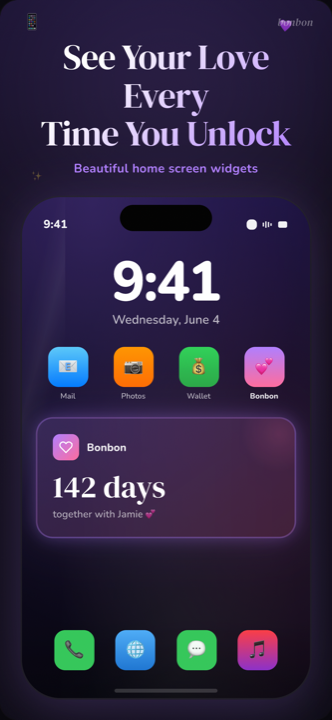
Pairing that with a Shared Diary for the small daily moments and a Love Counter that quietly tracks how long you've been together turns deep talk from a rare, effortful event into something that just happens on a normal Tuesday.
How Do You Keep Deep Talk From Becoming a Chore?
Don't ask a heavy question every single day. Deep talk works because it's a departure from the everyday, not because it replaces it. Mix in genuinely fun, low-stakes questions most days, and let the deeper ones show up once or twice a week, when there's actually time to follow the answer wherever it goes.
Also, let a conversation end without a neat conclusion. Not every deep question needs to resolve into a decision or a plan. Sometimes the point is just that you both said something true out loud, and that's enough to make the next ordinary day feel a little closer.
If you want the daily habit and the deeper cards to live in one place instead of scattered across apps, the app is built around exactly that — a small shared space for the two of you, wherever you both happen to be tonight.
What are good deep talk questions for a new couple?
Start lighter than you'd think: 'What does feeling loved actually look like for you?' or 'What's something you were afraid to tell me at first?' New couples do better with questions about the present and near future than with heavy childhood or fear-based ones right away.
How often should couples have deep conversations?
Once a week is enough to keep learning new things about each other without it feeling like a scheduled therapy session. Many couples fold one deep question into an existing nightly ritual or a weekly video call.
What if my partner doesn't want to answer a deep question?
Don't push. Say something like 'no pressure, we can come back to it,' and try a lighter question instead. Some people need to feel safe or unhurried before they'll go deep, and forcing it usually backfires.
Are deep talk questions good for long-distance couples?
Yes — they're especially useful for long-distance couples because they replace the small daily context you'd otherwise pick up just by being in the same room. A single deep question can carry a whole phone call.